Learning, Research,
and Social Action
The Center for Resilient Communities is an academic unit within the Eberly College of Arts and Sciences at West Virginia University where it serves as a university center for learning, research, and social action. Rooted in our land-grant mission, the CRC draws on the university's intellectual resources, public mission, and educational infrastructure to support long-term community-engaged partnerships.
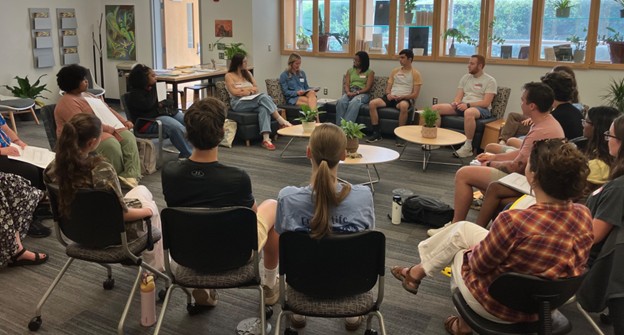
The CRC seeks to embody the highest aspirations of the land-grant university vision by preparing new generations of youth, students, grassroots leaders, and scholars to contribute to social, economic, and environmental change.
Learn more about:
Cultivating Agents of Change
The WVU Center for Resilient Communities is a university-based center for learning, research, and social action. We bring together students, scholars, and community partners to support more just, equitable, and vibrant communities.
The CRC's approach centers on learning through study, action, reflection, consultation in the advancement of community-based project partnerships. Across our programs, youth, students, adult learners, and community partners work together to better understand social and environmental challenges and respond to them. In the process, participants develop knowledge, relationships, and practical experience that strengthen communities and support their long-term wellbeing.
Central to our vision of building just and vibrant communities is resilience. At the CRC, we understand constructive resilience as the growing capacity of people and communities to sustain moral purpose, act with integrity, and work together in the face of changing and often difficult circumstances.
Each of our program areas contributes to this resilience by cultivating leadership, shared understanding, practical skills, and long-term relationships.
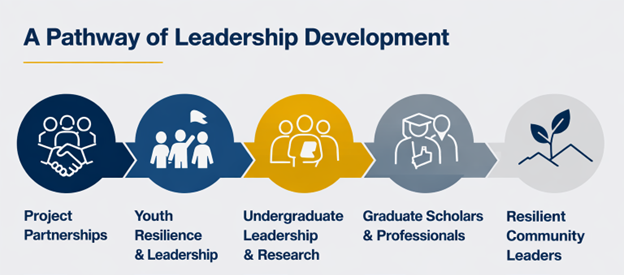
Project Partnerships
Community partnerships are at the heart of the CRC's work. We collaborate with organizations, local leaders, and institutions on long-term projects that respond to community aspirations and strengthen local capacity. These partnerships create opportunities for shared learning, practical research, and cooperative action across areas such as community development, environmental justice, food systems, and youth leadership.
Our goal is not only to complete projects, but strengthen local leadership, and contribute to lasting community wellbeing.
Youth Resilience and Leadership
The CRC is expanding pathways for younger people to participate in the transformation of their communities. Through the Youth Resilience Leadership program, high school students, educators, and community partners come together through a statewide Youth Summit at WVU to develop the confidence, resilience, and moral imagination needed to respond to difficulty without losing hope or purpose.
Young people are supported in carrying this work back to their schools and communities, where they receive continued mentorship and training to become agents of change in the places they love and call home.
Undergraduate Leadership and Resilience Research
Through a comprehensive leadership program including high impact experiences, research apprenticeships and internship programs, undergraduate students learn to collaborate with organizations, agencies, and community partners on long-term projects. These experiences build confidence, research skills, and enduring relationships between students and communities.
Students learn to apply their education in real-world contexts, while community partners gain valuable research support, planning capacity, and fresh energy for ongoing work.
Next Generation Scholars and Professionals
The CRC is cultivating a new generation of scholars and practitioners committed to research that is collaborative, community-engaged, and grounded in place. Graduate students and emerging professionals get training, earn certifications and work alongside organizations and local leaders across Appalachia while advancing research on issues of critical concern.
Our certification in community engaged research supports a model of academic and professional leadership that pairs rigorous scholarship with partnership, practical contribution, and long-term commitment to the communities they serve.
Global Partners,
Local Roots
UNESCO Knowledge for Change Consortium (K4C)
The WVU Center for Resilient Communities is a designated UNESCO Knowledge for Change (K4C) training hub, part of a global training consortium in community-based participatory research led by the UNESCO Chairs in Community-Based Research and Social Responsibility in Higher Education, Budd Hall and Rajesh Tandon. Through the K4C network, universities and community organizations form formal hub partnerships to train mentors, build research capacity, and support the co-creation of knowledge with communities. The K4C model emphasizes transformative learning, socially responsible higher education, and a mentor-training approach that helps strengthen community-university research partnerships around the world.
Center for Research on Education for Development (CRED)
The CRC has strong ties with the Center for Research on Education for Development (CRED), a research and educational organization devoted to strengthening the capacity of people working in grassroots development. Through education, research, and partnerships, CRED supports efforts to equip populations to promote the betterment of their communities and to generate knowledge that can guide more just and constructive forms of social change. CRED's work focuses on developing educational approaches and a research agenda that reflects a long-term commitment to participatory learning and the creation of knowledge rooted in practice.
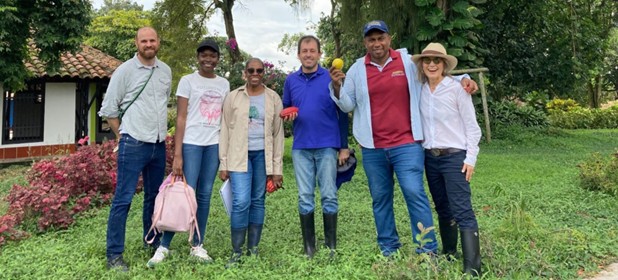
FUNDAEC's Growing Hope Systematization Team in 2023: Bradley Wilson with Dayaní Zapata, Maria Cristina Mosquera, Juan Fernando, Ever Rivera, and Haleh Arbab at the Educational Center and Regenerative Agriculture Demonstration Farm in Perico Negro, Colombia.
FUNDAEC — Fundación para la Aplicación y Enseñanza de las Ciencias

The CRC maintains a close relationship with FUNDAEC in Colombia, a pioneering institution in education for development whose ideas and experience have helped inform the center's thinking about participatory learning, leadership formation, and long-term community transformation. Founded in 1974, FUNDAEC develops educational programs, research, and practical initiatives that strengthen local capacity, support regenerative agriculture, and promote social and economic betterment in rural communities. Its approach is rooted in the conviction that education can help unlock human potential and enable people to contribute meaningfully to the wellbeing of their communities.
Today, FUNDAEC's work spans nonformal education, climate and ecological restoration, agricultural production and food systems, and community-based economic initiatives. Over more than five decades, it has become widely recognized for advancing a model of development grounded in dignity, participation, and learning in action.
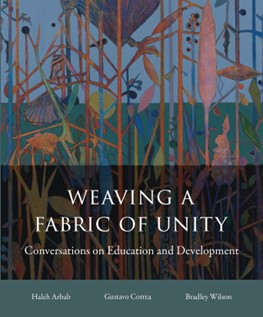
Dr. Bradley Wilson co-authored a new book Weaving a Fabric of Unity in 2025 with Dr. Haleh Arbab (CRED) and Dr. Gustavo Correa (co-founder of FUNDAEC).
